Nasu Rindoko Family Bokujo with Kids: Feeding Animals by a Mountain Lake (2026)
This post may contain affiliate links. If you book through them, I earn a small commission at no extra cost to you. Learn more.
If your kids love animals more than roller coasters, this is the Nasu day out to pick. Nasu Kogen Rindoko Family Bokujo (那須高原りんどう湖ファミリー牧場) is a farm park wrapped around a small mountain lake in the Nasu highlands — kids feed carrots to horses, bottle-feed calves, and scoop pellets for a whole herd of alpacas, while a ferris wheel and a lakeside carousel handle the "but I want to ride something" negotiations. There's even a zipline that crosses the lake itself.
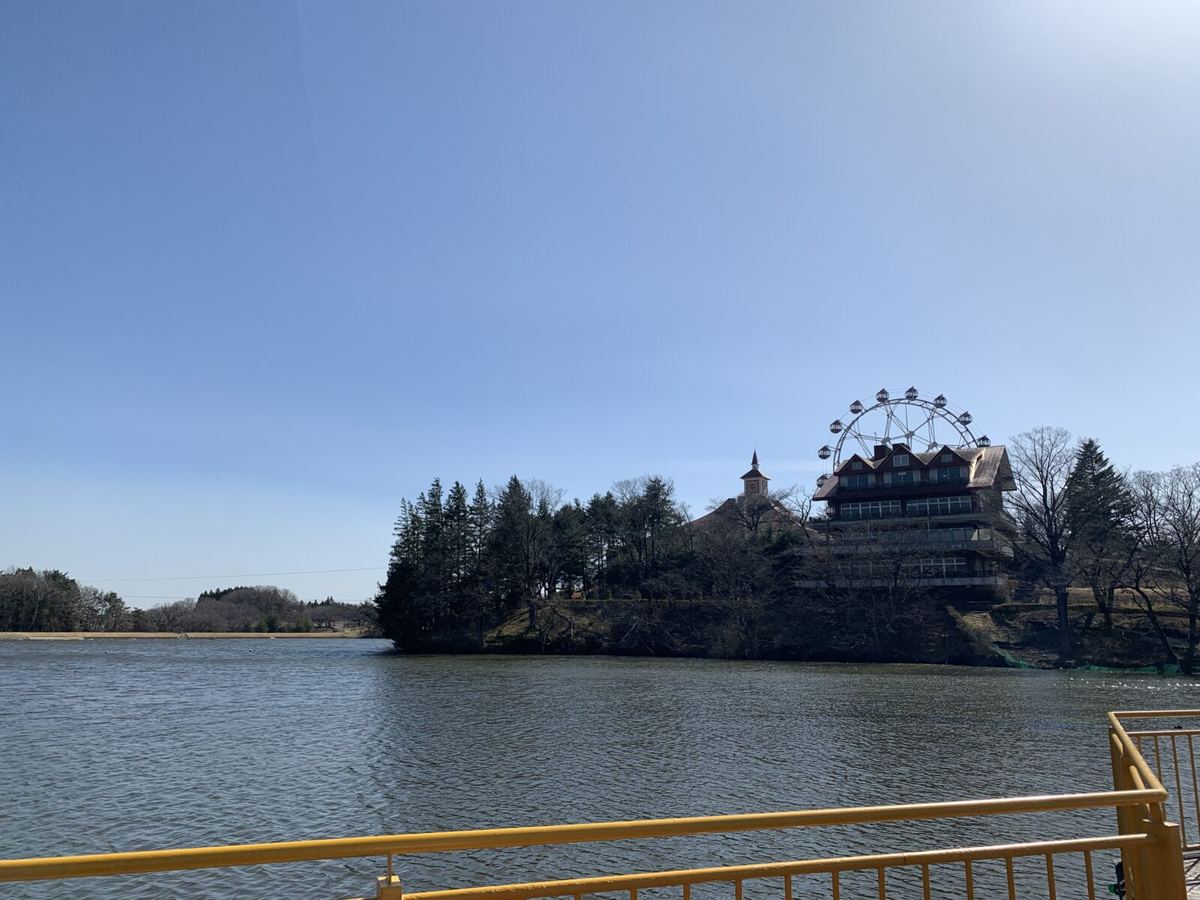 The whole park wraps around this lake — that's the ferris wheel on the far side, the tallest thing for miles.
We went as a family of three — my wife, our then-4-year-old daughter, and me — as part of a Nasu resort trip, and it paired perfectly with a hotel stay in the area. If you're also considering the ride-heavy option nearby, we did that too: see our guide to Nasu Highland Park, which suits older kids better. This place is the gentler, furrier of the two.
One honest note up front: the official website is Japanese-only, and getting here from Tokyo without a rental car takes a little planning. Both are solvable — this guide covers how.
Quick Facts
| Admission (adult, junior high+) | ¥1,600 (about $11) |
| Admission (elementary school) | ¥800 (about $5.50) |
| Admission (age 3–preschool) | ¥800 (about $5.50) |
| Under 3 | Free |
| Enjoy Pass (admission + unlimited rides + ¥1,000 park money) | ¥4,900 adult / ¥4,100 elementary / ¥3,800 preschool |
| Hours | Typically 9:30 AM–4:30 PM; later on event weekends (some fireworks nights to 8:00 PM) — the seasonal calendar governs |
| Winter closures | Closed Tue/Wed/Thu in Dec–Feb in recent years — always check the calendar |
| Time needed | Half day for the animals; full day with rides |
| Nearest station | Nasushiobara (Tohoku Shinkansen) or Kuroiso — then shuttle, taxi, or seasonal bus (see below) |
| Parking | ¥1,000 per car (free on off-peak weekdays) |
| Stroller rental | Yes, ¥500/day; 3 nursing rooms in the park |
| Re-entry | Same-day re-entry allowed |
| English support | Japanese-only official site, little English signage — but feeding animals needs no translation |
| Payment | Credit cards and PayPay accepted (a few coin-operated games are cash only) |
Tickets: gate is fine, but know your options
You don't need to book ahead for a normal visit — buy at the gate with a card, no Japanese required. The real decision is which ticket:
- Admission only is the right call if your kids are animal-first, ride-maybe. That was us. You can pay per ride for the one or two things they beg for.
- Enjoy Pass (admission + unlimited rides) makes sense for a full day with ride-loving kids. It also includes ¥1,000 of "park money" — a kid-currency called rindoru that preschoolers can spend on animal feed, ice cream, and juice inside the park, which our daughter's demographic finds extremely motivating.
- Twilight tickets for the last two hours run about half price — a nice trick if you're staying nearby and just want an animal fix before dinner.
Two things worth knowing: some partner hotels in the Nasu area sell discounted admission at their front desks (at the time of our visit, the discount was substantial — ask your hotel), and online pre-purchase runs through Japanese-only booking sites, so for most overseas visitors the gate is genuinely the simplest option.
Our visit: funnels, bottles, and one very determined calf
We visited on a weekday in March — spring break, technically, but the park was quiet enough that the carousel was effectively our daughter's private ride.
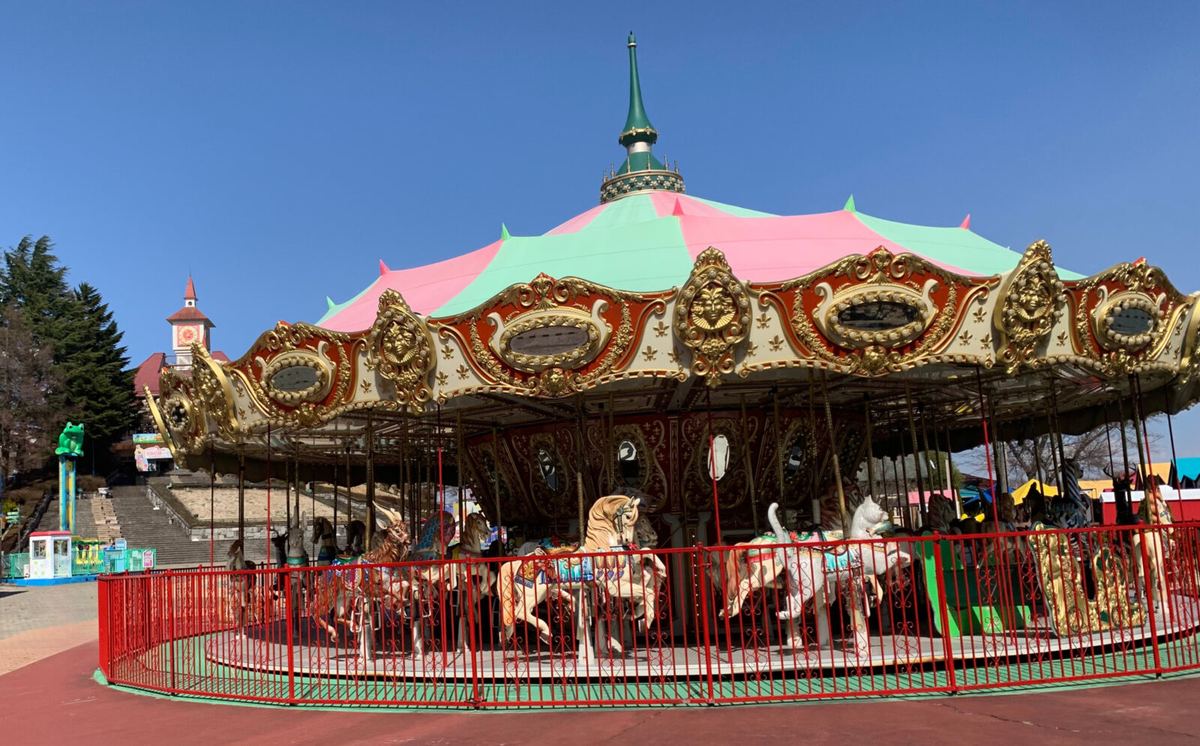 A weekday in the off-season means no lines. Our daughter treated the carousel as unlimited.
We came for the animals, so we skipped the Enjoy Pass — though we did cave on the ferris wheel ("Papa, I want to ride it"), and I'm glad we did. There's nothing tall anywhere near this park, so the view from the top stretches absurdly far across the Nasu highlands. A little road train shuttles you from the entrance gate to the ride and farm areas, which saved small legs some walking.
The farm area is the heart of the place. Feeding portions cost around ¥300 each, milk included, and the park has quietly engineered the whole experience for small, nervous children:
- Horses are fed in the stable through a funnel — you drop the carrot in a chute instead of holding it on your palm, so tiny fingers never go near teeth. Our daughter was still scared ("Scaaary!"), to which I pointed out she was literally using a funnel. She remained unconvinced. Parenting.
- Goats, sheep, and alpacas get round pellets served from a small scoop rather than by hand — again, bite-proof by design. Our daughter was once nipped by an alpaca at a ski resort petting area, so she approached this one like a bomb-disposal expert. The scoop system eventually won her over.
- Bottle-feeding a calf was the runaway highlight. Staff fill an enormous baby bottle with milk, you carry it to the calf barn, and then you discover that a calf drinks with the pulling force of a small tractor — our daughter got yanked back and forth like she was in a tug-of-war, laughing the entire time.
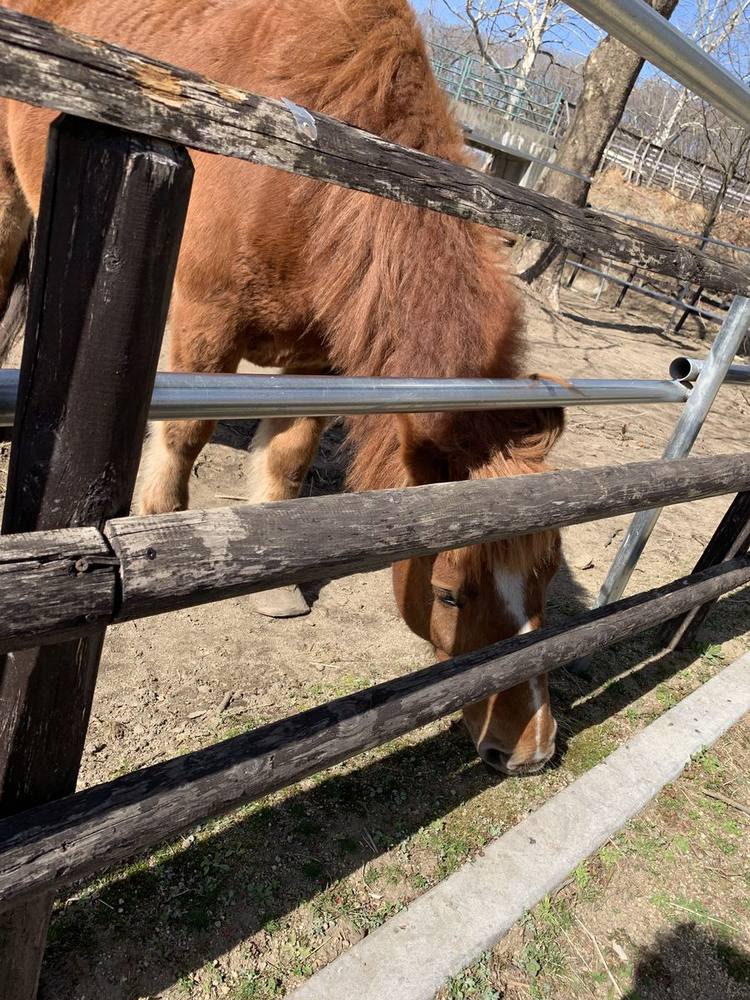 Off-duty and entirely unbothered. The farm area lets you get close even outside the paid experiences.
Hand-washing stations with foaming soap sit right at the exit of the feeding areas — the hygiene setup genuinely impressed me.
One honest caveat: on our weekday visit, several of the paid experiences — cow milking, pony rides, the rabbit-and-guinea-pig room, alpaca walks — were suspended for the day. That stung a little, since the milking and pony rides are headline activities. My read is that weekends and holidays are the safer bet for the full experience menu; if a specific activity is the reason you're coming, check the official site's schedule that morning.
Even with the suspensions, the animals were everywhere and very visible — including a large herd of alpacas who, on our windy March day, had huddled into one judgmental fluffy mass.
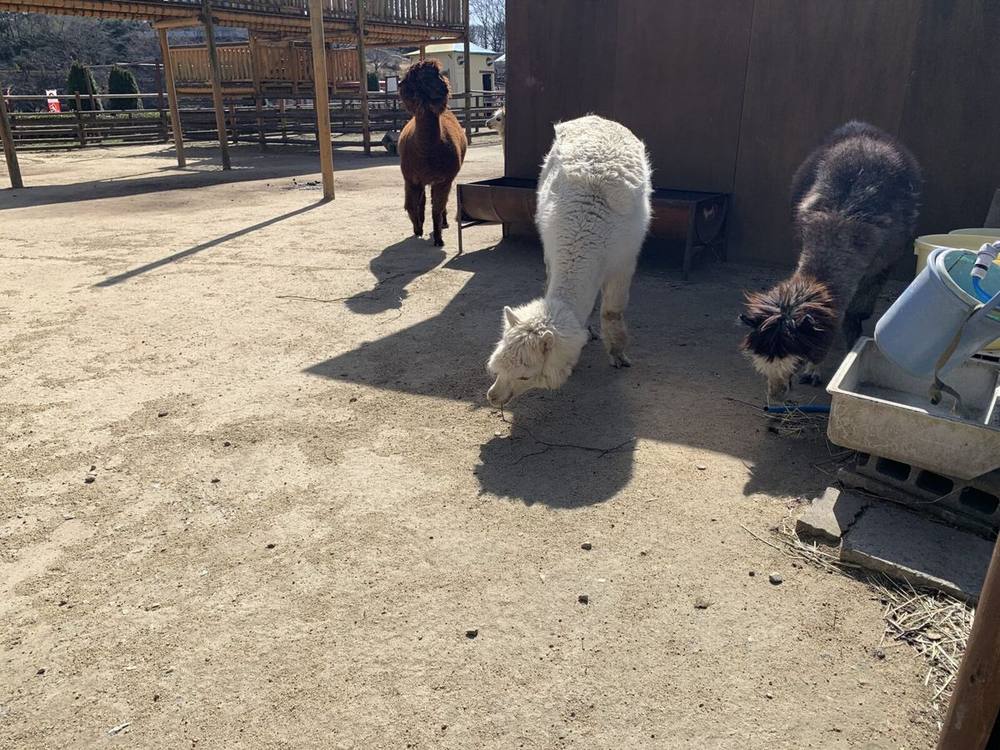 The alpaca herd on a cold, windy day — huddled up and conserving warmth. The net structure above them is a paid net-athletic course where kids can look down on the alpacas from the air.
The zipline across the lake
The park's flagship thrill is KAKKU, a zipline that runs about 220 meters straight across the lake and back. It's ¥1,500 (¥1,000 with the Enjoy Pass), runs on timed slots, and is restricted to roughly elementary 3rd grade and up with weight limits — so our 4-year-old was out, but if you have a bigger kid, gliding over an actual lake is a legitimately rare offer. It shuts down in bad weather, so treat it as a bonus, not a promise. Lower-key lake options: a cruise boat crossing the lake (¥600), pedal boats, and pedal karts along the shore.
What Locals Know
- The station shuttle requires a phone reservation the day before. The park runs a free shuttle from Nasushiobara Station, but it departs at 10:00 AM only, runs weekends/holidays (daily in mid-August), and must be reserved by 4:00 PM the previous day — by phone, in Japanese (0287-76-3111). If your hotel concierge can make the call for you, this is the best deal in Nasu. Details below.
- Check the calendar before a winter visit. In recent years the park has closed Tuesdays through Thursdays from December to February, and daily hours shift with the season. The Japanese-only calendar on the official site is the single source of truth.
- Weekday visits are gloriously empty, but activities get cut. Our March weekday meant zero lines — and a shorter menu of animal experiences. Weekends flip that trade.
- Twilight tickets are the resort-stay hack. Staying in Nasu anyway? The half-price last-two-hours ticket plus the evening light on the lake is a lovely, cheap end to a day.
- The zipline is weather-hostage. Wind or rain cancels KAKKU. If it's the main event for your older kid, have a backup plan.
Food, nursing, and the glamping domes
The park has a few restaurants, though on our off-season weekday only some were open. Midori-chan's Jersey Milk House does light meals and the soft-serve ice cream that seemingly everyone in the park was holding — it's made with the farm's own Jersey milk, and it's the correct order. Cantine handles proper lunches (BBQ, ramen and more), and the Mekke! cafe by the entrance gate is the other solid sit-down option. For facilities, this park is better equipped than its retro looks suggest: three nursing rooms, stroller rental at ¥500/day, and same-day re-entry if you need to pop out to the car.
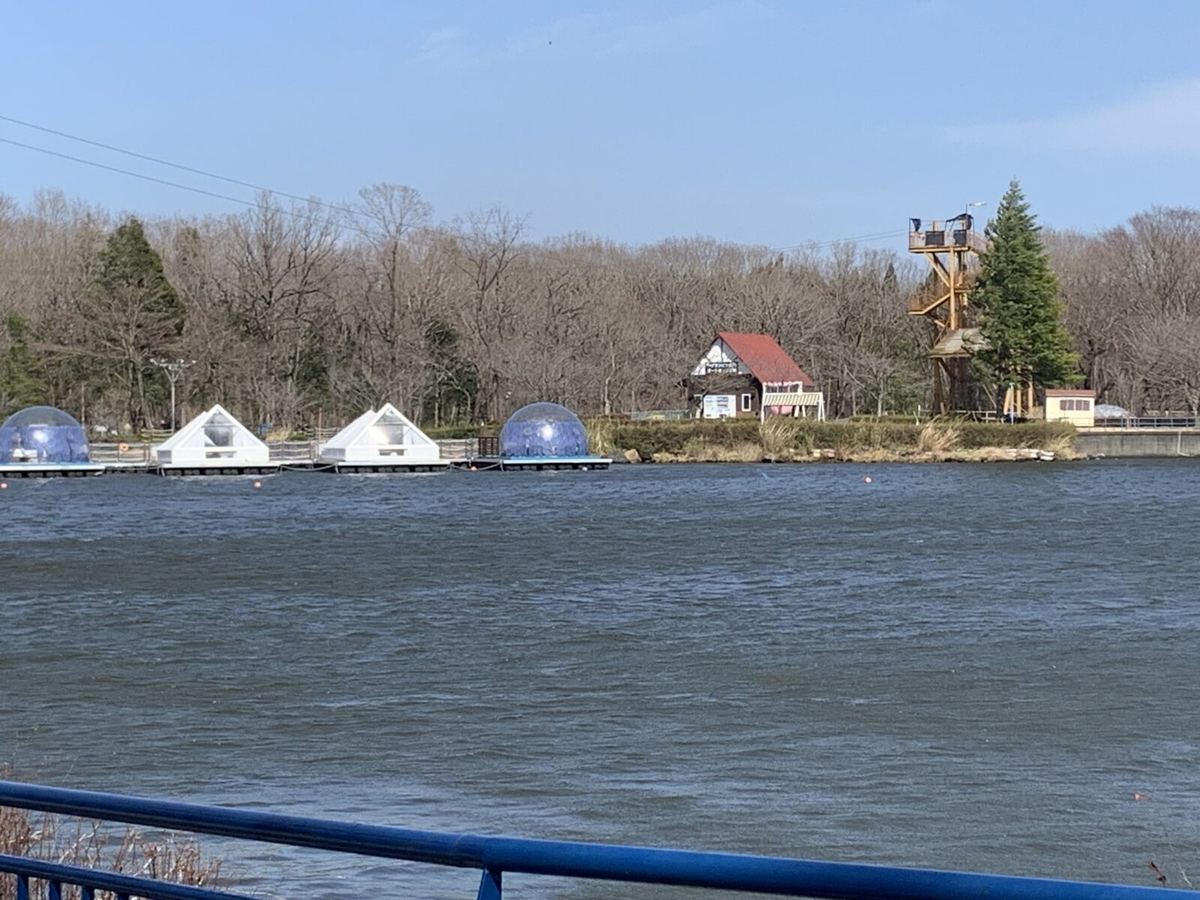 Those domes across the water are the park's glamping site — including tents that float on the lake itself.
We didn't stay overnight, but the park runs a glamping operation on and around the lake — lakeside dome tents, alpaca-adjacent tents where the animals wander close, and floating tents on the water, reportedly Japan's first lake glamping. Our daughter's review of the transparent domes: "so see-through!" It's on the wish list for next time.
Getting There from Tokyo
Here's the honest part. The Shinkansen leg is easy; the last few kilometers are the puzzle, because the park sits in the highlands away from any train line.
Option 1 — the free shuttle (best if you can book it). The park's own shuttle leaves Nasushiobara's West Exit at 10:00 AM — that's the only departure — on weekends and holidays (daily in the mid-August holiday period). It must be reserved by 4:00 PM the day before, by phone at 0287-76-3111, and the call is in Japanese. That's a real hurdle for overseas visitors; the practical workaround is asking your hotel front desk or concierge to make the call. If it works, your transfer costs nothing.
Option 2 — taxi. About 20 minutes from Kuroiso Station (one local stop from Nasushiobara) or 30–40 minutes from Nasushiobara itself. Costlier, but it runs on your schedule and swallows strollers without drama. This is what I'd plan around if the shuttle call isn't possible.
Option 3 — the seasonal loop bus (budget fallback). From roughly April to November, a sightseeing loop bus circles the Nasu attractions for about ¥800 a ride. It's cheap but slow and infrequent — workable if you're already hopping between Nasu sights, frustrating as your only plan with tired kids.
By car: if you've rented one for Nasu (which honestly suits this region best), the park has a big lot at ¥1,000 — free on off-peak weekdays.
How much English will you need?
Almost none inside the park — feeding a goat is a universal language, ride restrictions are mostly height/age based, and payment is tap-and-go with a credit card. The friction is all before the gate: the official site, its calendar, the shuttle reservation line, and the online ticket channels are Japanese-only, with no English page. My advice: use your phone's translation on the official calendar to confirm the day's hours and any activity suspensions, and outsource the shuttle phone call to your hotel. No English-speaking staff are advertised, but we saw nothing that would actually stump a visiting family.
Verdict
Rindoko Family Bokujo is a great pick for animal-loving kids roughly ages 2–9, especially as part of a Nasu resort stay — the feeding experiences are thoughtfully engineered for small children, the lake setting is genuinely pretty, and a half day covers the farm at a relaxed pace. Add the Enjoy Pass and rides to stretch it to a full day, or send an older kid across the lake on the zipline.
It's not the right pick if your kids are thrill-first (that's Nasu Highland Park's department), if you're visiting midweek in winter without checking the calendar, or if a no-car, no-shuttle transfer would sour the day for your crew. The park has a slightly retro, unhurried feel — after Tokyo's crowds, a place with more animals than people was exactly what we needed.
This review reflects our family's actual visit. Prices, hours, closure days, and activity schedules change seasonally — always check the official Rindoko Family Bokujo website (Japanese only) before you go. Questions? Contact me — I'm happy to help fellow parents plan.
Written by Tokyo Dad, a Japanese dad sharing family visits in Japan.