Nakayama Racecourse with Kids: Chiba's ¥200 Playground Day Out (2026)
This post may contain affiliate links. If you book through them, I earn a small commission at no extra cost to you. Learn more.
Here's a sentence I didn't expect to write: one of the best-value family days out near Tokyo is at a horse racing track. Nakayama Racecourse in Funabashi, Chiba — run by the JRA, Japan's national racing organization — has a big outdoor playground in the middle of the track, a free indoor playroom produced by Bornelund (the company behind Japan's beloved KID-O-KID play centers), and pony events for kids. Admission is ¥200 on race days, free for anyone under 15, and completely free on non-race "Park Wins" days.
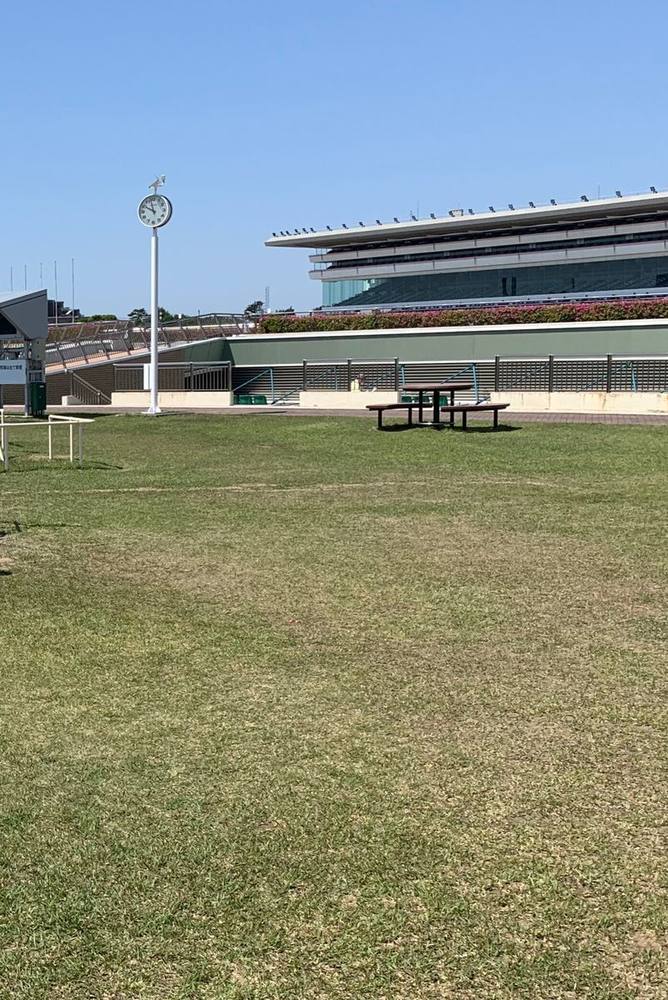 The grandstand and the lawn. The playground sits in the infield — the grassy area inside the track itself.
If you've read my Funabashi Andersen Park guide, this is the same corner of Chiba, and the two pair well across a weekend — especially if you're staying near Tokyo Disney Resort, which is a short hop away in Urayasu. We stayed at a Disney-area hotel the night after our visit and it worked beautifully.
My first reaction when someone suggested taking a child to a racecourse was, honestly, "is that... okay?" It is. Japanese racecourses are deliberately built as family destinations, and the play facilities are physically separate from the betting areas. My impression after a day there: it's a big public park and a shopping-mall indoor playroom that happen to share an address with a racetrack.
Quick Facts
| Admission (race days) | ¥200 (about $1.30); under 15 free |
| Admission (Park Wins / non-race days) | Free for everyone |
| Tickets | Same-day cash tickets at the gate — no booking needed |
| Race days | Sat/Sun during Nakayama meetings (roughly Jan, Mar–Apr, Sep, Dec) |
| Kids playground (Uma Kids Hiroba) | Free, outdoor, in the track infield |
| Indoor playroom (Uma Kids Room) | Free, ages 6 months–12 years, 40-min sessions, reserve via free JRA app |
| Time needed | Half day to full day |
| Nearest station | Funabashi-Hoten (JR Musashino Line), then a dedicated underground passage |
| Nursing/diapering | Baby corner on Stand 1F (pillar 39), nursing room on Stand 2F (pillar 33) |
| English signage/staff | Limited on-site; official JRA English page and English leaflet PDF available |
One thing to know upfront: the play facilities are a race-day and event-day thing. On days when nothing is scheduled at all, the grounds — and the underground passage from the station — are closed. Check the JRA calendar before you plan (more below).
Our Visit: A Racecourse with No Races
We went on a day in May with our then-5-year-old daughter — and as it turned out, not only were there no big races, there were no races at Nakayama at all that day (an off-track "Park Wins" day, when the facility opens for people to watch and bet on races elsewhere). Admission was free, the crowds were thin, and it was one of the most relaxed play days we've had anywhere.
First stop was Uma Kids Hiroba ("Horse Kids Plaza"), the outdoor playground in the infield. Plenty of local kids were already running around when we arrived. The centerpiece is the Kumo no Juutan — "carpet of clouds" — a big white inflated dome that kids bounce on like a trampoline. Entry runs in timed groups with a staff member managing the line; on our quiet day, waiting through one rotation was enough to get in. Everyone goes barefoot, parents included if you climb on, and there's a firm no-phones-in-hand rule while bouncing — the staff will call you out on it (ask me how I know).
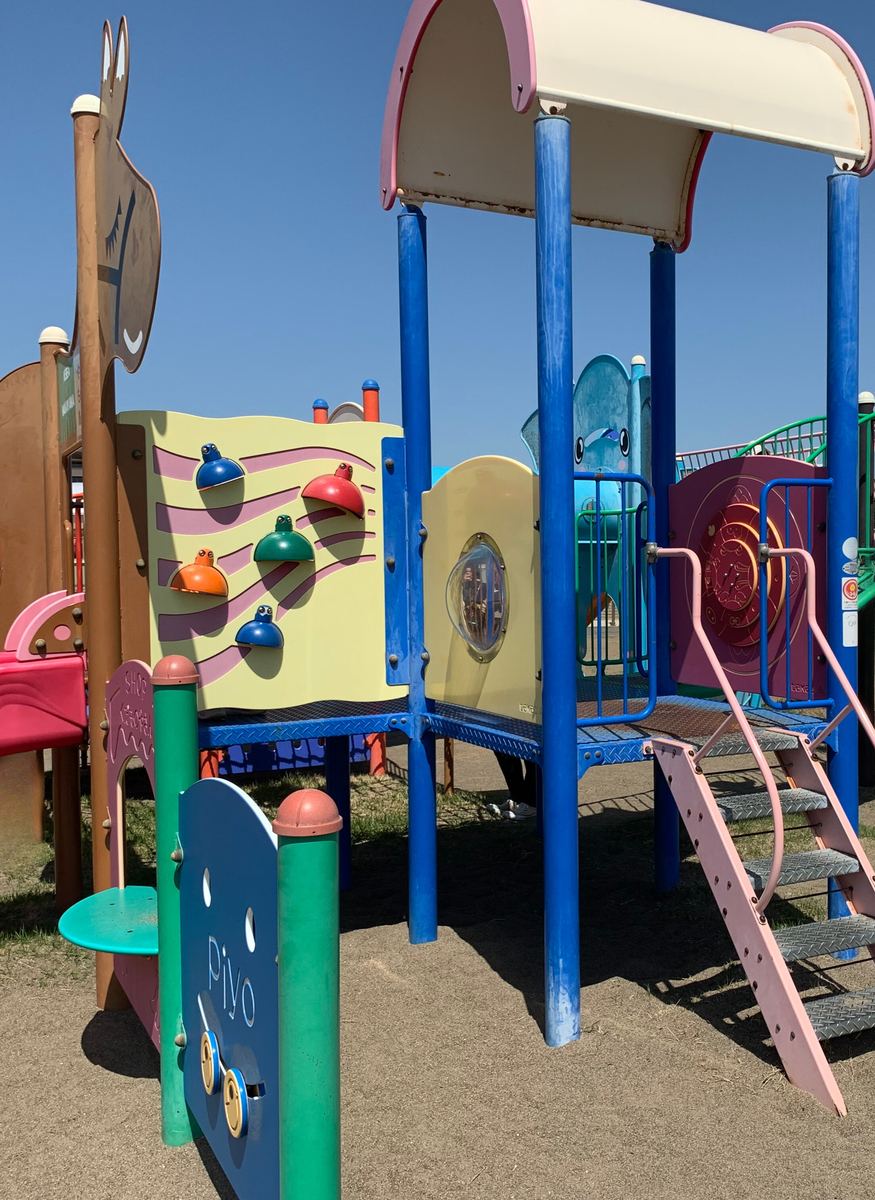 The rest of Uma Kids Hiroba: standard-issue park equipment done well, on grass. The spring rockers are shaped like horses, naturally.
Around the dome is a full lineup of regular playground equipment — and in a nice on-theme touch, the spring rockers you'd normally see as pandas or ducks are horses here. My daughter worked through every single piece of equipment like it was a checklist. The whole area is surrounded by open lawn, which is lovely, but note that there's very little shade: even in May, the sun was intense. Hats, sunscreen, and cold drinks are not optional in warm months (drinks are sold on-site).
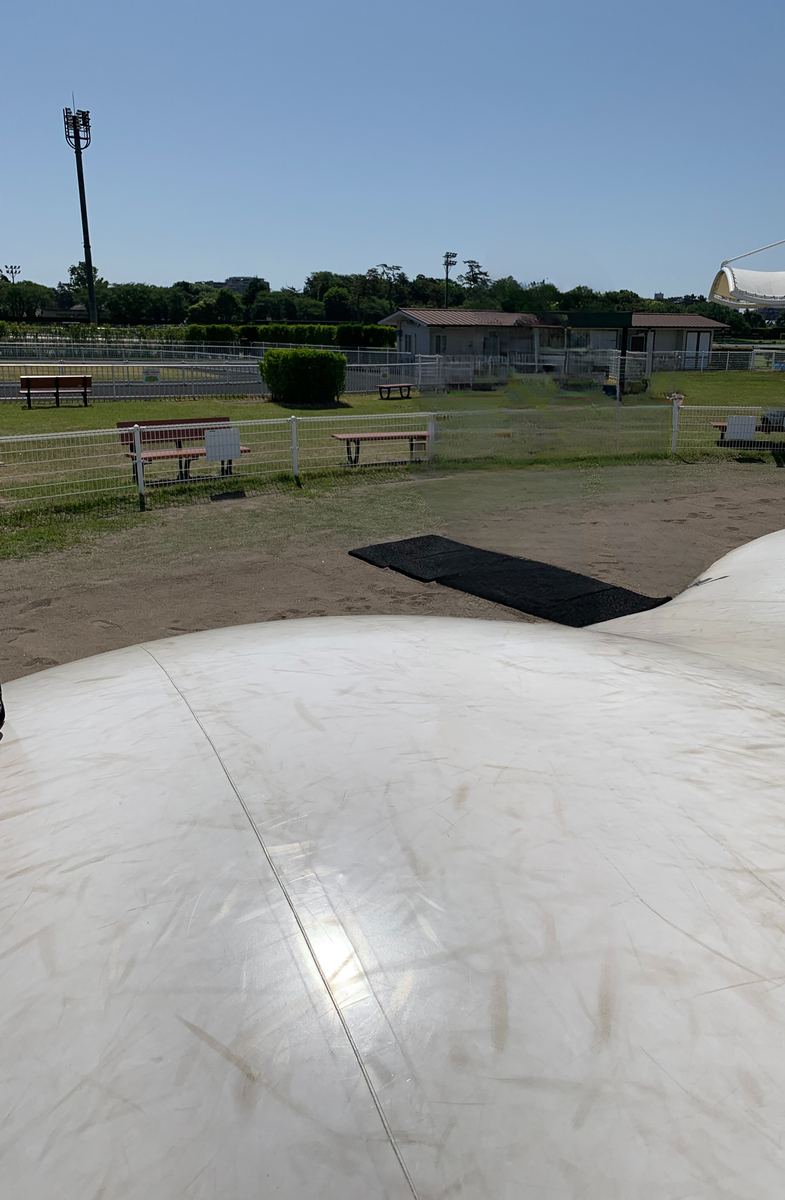 Kumo no Juutan, the "carpet of clouds." Barefoot only, timed entry, and no phones in hand while you bounce.
The day's special event was a pony walk at the Pony Rink — kids aged 3–12 get to lead a pony by the reins. It's free but lottery-based: you apply through the JRA event app during a set window (11:00 AM on our visit), and you have to physically be inside the racecourse with location services on for the app to accept your entry. I'm reporting this system with painful accuracy because I forgot to apply, a failure my daughter has not fully forgiven. Learn from me: set a phone alarm.
The indoor half of the day was Uma Kids Room, a free playroom produced by Bornelund, the company behind the KID-O-KID indoor play centers Japanese parents pay good money for. It runs in 40-minute sessions, six per day from 10:00 AM to 3:40 PM, for kids from 6 months to 12 years with an adult (one session per child per day, up to six people per booking). Inside it's genuinely KID-O-KID quality: ball-run toys for the 1-year-old crowd, a play kitchen, a slide, even a little climbing wall. My daughter went full-throttle for the entire 40 minutes — and at one point handed a toy to a smaller child unprompted, which I'm still dining out on emotionally.
What Locals Know
- Get the JRA event app before you go — it's the key to everything. The pony events and the Uma Kids Room both require the free "JRA競馬場イベント参加アプリ" (JRA racecourse event participation app). Two catches: JRA publishes several apps, so make sure you have the event participation one; and it only activates when you're inside the racecourse with location services on. Playroom slots are first-come from 9:30 AM — book your preferred time the moment reservations open. I took a 12:00 slot hoping it'd be quieter (it wasn't).
- Avoid the Arima Kinen. In late December, Nakayama hosts the Arima Kinen, one of the biggest race days in the world — six-figure crowds, and reserved seats allocated by advance lottery with a two-per-person cap. It is emphatically not a casual family day. Big graded-race days in general mean big crowds; a plain race day or a Park Wins day is a far better first visit with kids.
- Nakayama vs Tokyo Racecourse. The Kanto region has two JRA tracks: this one and Tokyo Racecourse in Fuchu. Tokyo Racecourse is bigger with more elaborate events — but correspondingly more crowded. If your kids (or you) don't love crowds, Nakayama is the calmer pick. Staying closer to central Tokyo? See my Tokyo Racecourse guide.
- The station passage has hours. The underground passage from Funabashi-Hoten Station opens only on race and Park Wins days and closes around 5:20 PM. Plan your exit before then, or you're rerouting.
- Not all racecourses are like this. JRA's national tracks have serious kids' facilities; smaller local (non-JRA) tracks often don't. Don't assume this article generalizes to every racecourse in Japan.
- On Park Wins days, the Keyaki Koen garden area also opens — a pleasant extra wander if you have time.
What About the Gambling Part?
Fair question. Betting is legal here, restricted to adults 20 and over, and happens at open-plan ticket machines and windows — you'll walk past people studying racing forms, and it's about as menacing as a train station. The play areas are separate, and families simply spend their day on the playground side. Smoking is confined to designated areas.
Food, Diapering, and Nursing
We ate ramen at the basement-level north food court — decent, cheap, but finding seats took real time even shortly after 11:00 AM, and we ended up racing the clock to our playroom reservation. In spring or autumn, the smarter move is the local one: bring a picnic and eat on the infield lawn. There's also a free indoor family eating space in the infield area (open until 4:00 PM) where you can eat food you've brought — a lifesaver in hot or rainy weather.
For babies: there's a Baby Corner on the 1st floor of the grandstand (near pillar 39) and a nursing room on the 2nd floor (near pillar 33). For a "sports venue," the family infrastructure is better than you'd guess.
Getting There
From central Tokyo, this is a genuinely easy trip — with one honest warning about Tokyo Station itself.
The warning: the Keiyo Line platforms at Tokyo Station are famously far from the main concourse — allow 10–15 minutes of walking (there are moving walkways) before you even board. Total from the Tokyo Station concourse is about 45 minutes and ¥440 by IC card.
The train detail that trips people up: you want a Keiyo Line train that continues through onto the Musashino Line — look for trains bound for Fuchu-Hommachi via Nishi-Funabashi. If you board a plain Keiyo Line train instead, no disaster: just change at Nishi-Funabashi or Minami-Funabashi for the Musashino Line (same fare).
The underground passage from Funabashi-Hoten is a highlight in itself: officially the "Memorial Walk," it has moving walkways most of the way and walls lined with photos of famous winning racehorses. My daughter's excitement level went noticeably up in a corridor, which I did not have on my bingo card. But remember: the passage only opens on race and Park Wins days, and closes around 5:20 PM. On non-event days everything is closed anyway; if you're visiting for some other reason, it's a bus from Nishi-Funabashi Station (about 15 minutes).
There's also a walking route from Higashi-Nakayama Station on the Keisei Line, but it's longer and runs along ordinary roads — with a small child, the traffic-free underground passage from Funabashi-Hoten is the clear choice.
How much English will you need?
Not much, but do your homework the night before. JRA has an official English page for Nakayama Racecourse plus a downloadable English leaflet PDF — save it before you go. On-site signage and staff are mostly Japanese-only, and the event app is in Japanese, so booking the playroom or entering the pony lottery takes some phone-translation patience (the app itself is free and the flows are short). Gate admission is a simple ¥200 cash transaction that needs no Japanese at all.
Verdict
Nakayama Racecourse is a genuinely fun, absurdly cheap family day out — ¥200 at most for adults, free for kids, with a bouncy dome, a quality free indoor playroom, ponies, and lawn space to burn off an entire small child's worth of energy. It's best for kids from toddler age through elementary school, and it slots neatly into a Chiba-side itinerary with Funabashi Andersen Park or a Tokyo Disney Resort stay.
It's not the right pick on major race days (especially the Arima Kinen in late December), and it requires a little planning literacy — checking the JRA calendar for a race or Park Wins day, and downloading the event app for the playroom. But if the idea of "take the kids to the races" makes you raise an eyebrow, I get it — and I'd tell you to go anyway.
This review reflects our family's actual visit. Race schedules, event lineups, and app-based reservations change season to season — always check the official JRA English site before you go. Questions? Contact me.
Written by Tokyo Dad, a Japanese dad sharing family visits in Japan.