Ikoma Sanjo Amusement Park with Kids: A Mountaintop Time Capsule Above Osaka (2026)
This post may contain affiliate links. If you book through them, I earn a small commission at no extra cost to you. Learn more.
If you're staying in Osaka with a preschooler or early-elementary kid and want a low-stress, no-lines amusement park day with a spectacular view thrown in, Ikoma Sanjo Amusement Park is a genuinely good half-day trip. Entry is free — you pay per ride — the rides are scaled for little kids, and you get there on a dog-and-cat-themed cable car that most children will remember longer than the rides themselves.
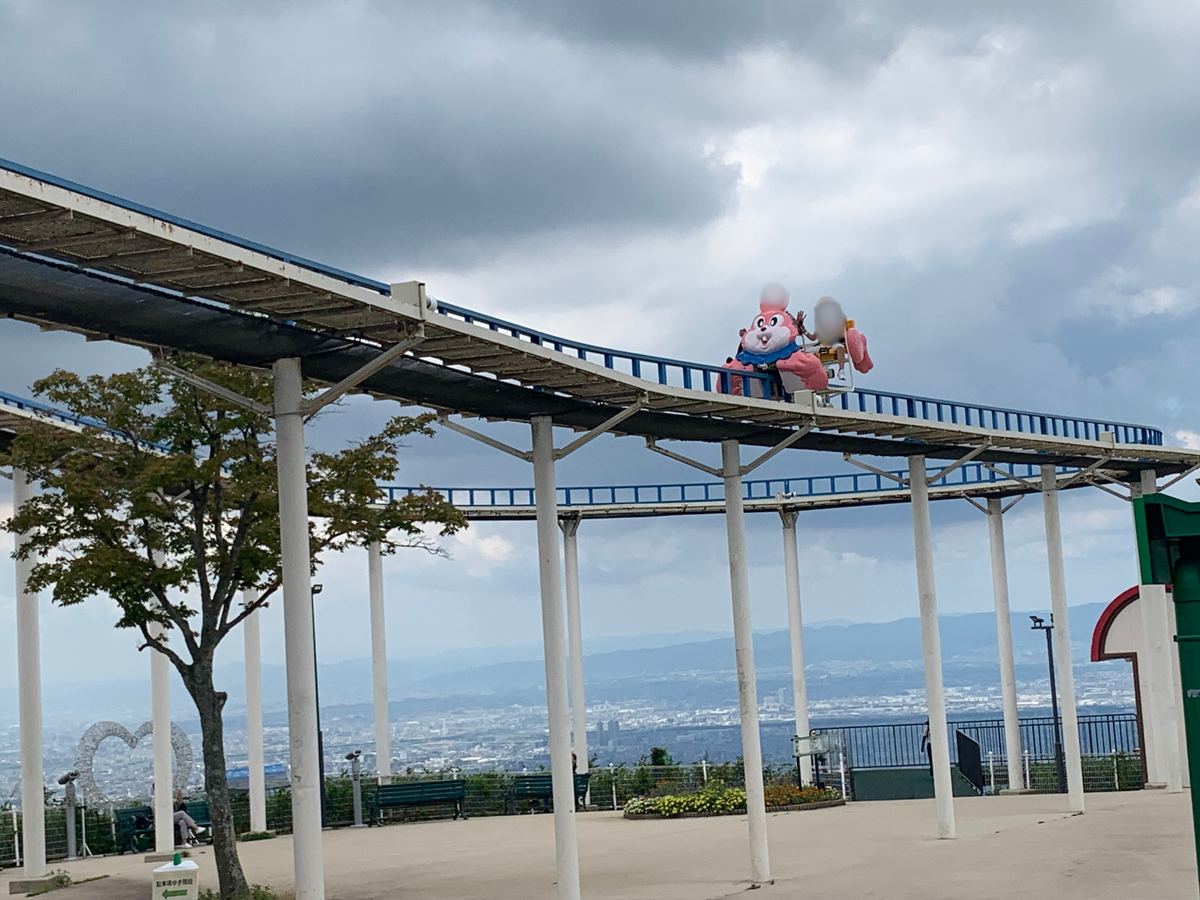 This is the park's whole pitch in one image: gentle kiddie rides, and the entire Osaka Plain as the backdrop.
As a dad who grew up in Osaka, I have a personal stake in this one: my parents took me here as a kid, and I recently went back for the first time in roughly 30 years — this time with my own 4-year-old daughter and her grandparents. It's a retro park, not a polished modern one, and this guide is honest about both sides: what's charming, what's dated, and the closure calendar that catches people off guard.
Quick Facts
| Admission | Free — you pay per ride (¥300–600 each; e.g. merry-go-round ¥400, Flying Tower ¥600) |
| Free Pass (same-day unlimited rides) | Adult ¥4,200 / elementary ¥4,000 / toddler age 2+ ¥3,000 |
| Toku-toku ticket book | 12 ride coupons for ¥3,600, shareable within your group |
| Season | March 7–December 6 (2026) — closed all winter |
| Closed day | Thursdays (plus a few extra dates — check the official calendar) |
| Hours | Typically 10:00 AM–5:00 PM (to 4:00 PM in November; some summer nights run to ~8:00–9:00 PM) |
| Time needed | Half day |
| Nearest station | Ikoma-Sanjo (top of the Ikoma Cable line) — the park entrance is right at the station |
| Stroller rental | None — bring your own or use a carrier |
| English support | Official site is Japanese-only; expect Japanese-only signage and staff (more below) |
| Payment | Restaurants take cards and QR payments; prices as of 2026 |
Tickets: skip the math, or don't
There's no entry gate to pay at — you walk in free and pay per attraction, mostly ¥300–600 a ride (Hot Air Flight ¥300, merry-go-round ¥400, haunted house ¥500, Flying Tower ¥600). That gives you three options: pay-as-you-go, the Free Pass (same-day unlimited rides), or the "Toku-toku" book of 12 ride coupons for ¥3,600, which your whole group can share.
Here's what we actually did, and I'd do it again: a Free Pass for our daughter, who rode everything repeatedly, and one shared Toku-toku book for the three adults, who took turns accompanying her. We ended up buying about four extra coupons on top of the book, and it still beat buying three adult Free Passes. Unless both parents genuinely plan to ride all day, one kid Free Pass plus a shared coupon book is the sensible configuration for most families.
There's no advance booking to worry about and no third-party ticket sites to compare — buy everything at the park. Current prices and the ride list are on the official site (Japanese only).
What is Ikoma Sanjo?
It's an amusement park on the summit of Mt. Ikoma, the mountain ridge between Osaka and Nara, and it's been there since 1929. That age shows — this is a retro park in the truest sense, with a hand-painted-sign, Showa-era atmosphere rather than themed lands and mascots. The signature attraction, the Flying Tower, is a slow-spinning aerial carousel that I've never seen at any other park, and to me it is Ikoma Sanjo.
What makes the park work isn't any single ride — it's the setting. The moment you walk in, the Osaka Plain opens up below you on the right, and on a clear day you can see essentially the whole city. Search for night photos of this park and you'll see why locals come up here on summer evenings.
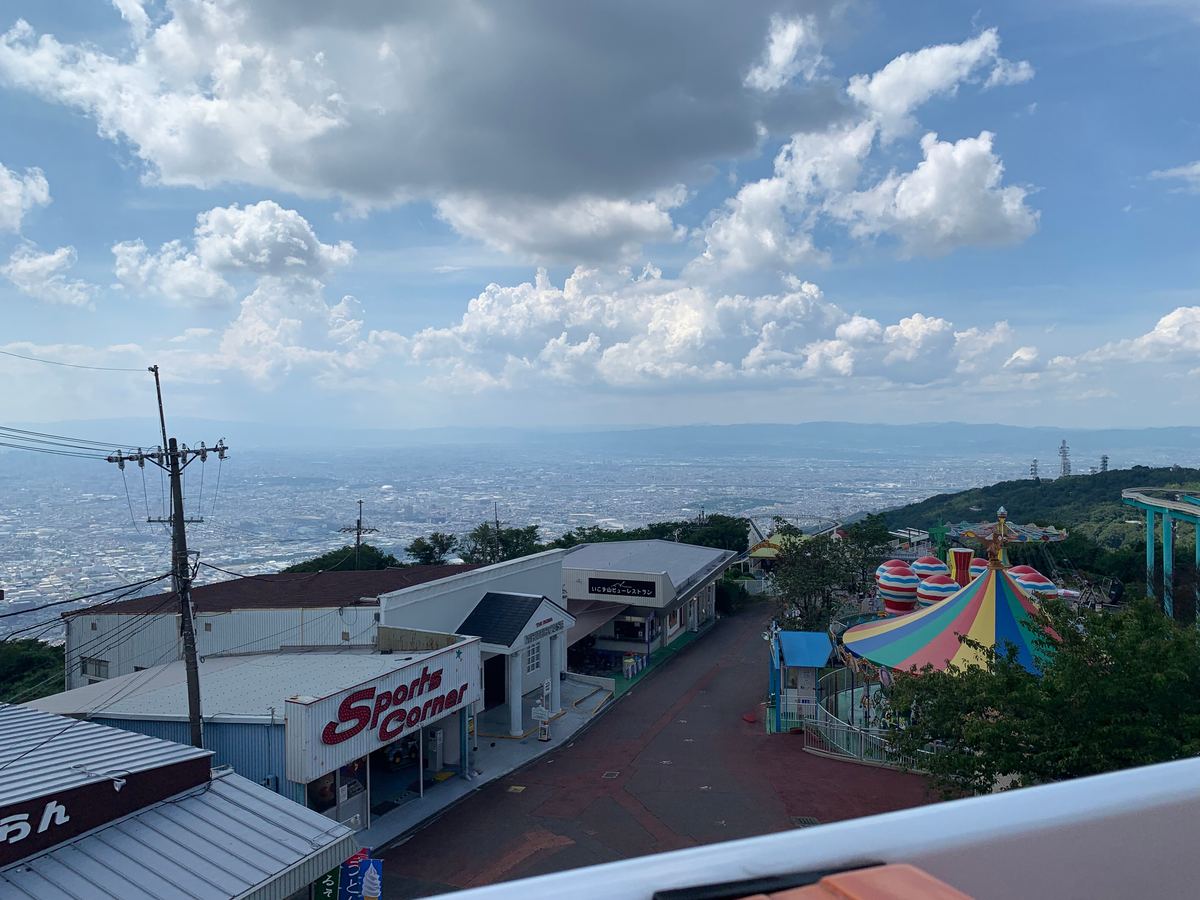 The view over the Osaka Plain is the real headliner — every ride here comes with it for free.
There's also PLAY PEAK ITADAKI, a Bornelund-supervised indoor-outdoor play facility for roughly ages 1–12 (¥1,500 for kids age 2 through elementary school, ¥600 for age 1, ¥600 per guardian), with all-day access and same-day re-entry. It mainly opens on weekends and holidays plus select weekdays, so check its calendar before promising it to your kids.
What Locals Know
- The park closes for the entire winter — the 2026 season runs March 7 to December 6, and it's shut from early December to early March. It's also closed most Thursdays, plus a handful of extra dates scattered through the year. Always check the official calendar before building a day around it.
- Mountaintop weather is its own thing. It's cooler than the city below — genuinely pleasant compared to an Osaka summer, though when we went in July it was still hot in the sun. More importantly, rides stop in rain or strong wind, and only about seven indoor attractions keep running in rain. If the forecast is bad, save it for another day.
- Buy the "Norinori Kippu" for the cable car. The same-day round-trip ticket (¥600 adult / ¥300 child) is cheaper than two one-way fares and covers the whole climb.
- Almost nobody waits in line. This was the thing that floored me on our visit: in an era where every attraction anywhere has a queue, we rode nearly everything with zero wait. It may not be flattering to say, but the emptiness is the luxury.
- Picnics are allowed. There are lawns where you can spread out your own food — a good hedge against the restaurant situation at lunch (see below).
Our Visit: 30 Years Later, With My Daughter
Full disclosure: I may have enjoyed this trip more than my daughter did. Coming back to a park you last saw as a child, now holding your own kid's hand, does something to you.
We started with the cycle monorail that runs along the edge of the park with that full Osaka view — grandma rode with our daughter, who contributed approximately zero pedaling, so grandma got a workout within the first ten minutes of the day.
Then came the stretch that quietly wrecked me as a dad: my 4-year-old announced she was riding the chain tower — the classic spinning swing ride — alone. And she did. I was still processing this milestone when she proceeded to ride the Happy Kangaroo (a gentle hop-up-and-down tower) alone, grinning before it even started moving, and then the merry-go-round alone. That last one came with a twist: with the entire carousel nearly empty, another child climbed into her carriage anyway, and my daughter spent the full ride frozen in silent alarm. Kid logic is undefeated.
The Flying Tower we rode as a family of three, and it's the ride I'd tell you not to skip — a slow rotation high over the mountaintop with Osaka on one side and Nara on the other.
The surprise hit was the Gold Rush log flume. With no crowds, each boat carried just one family, and it was the only attraction we rode twice at our daughter's insistence. Kids can ride from age 3 with an adult. We also worked through the Water Shot target-shooting ride, the "fun bicycles" area with its fleet of odd-shaped bikes, the Pukapuka Panda suspended monorail, a gentle spinning coaster, the Swinging Bear, the pedal-powered Hot Air Flight (think Dumbo, but your legs are the motor), a mini pirate ship, and Catch the Flash — an indoor button-pressing reflex game that was the one thing we waited for, about three groups deep.
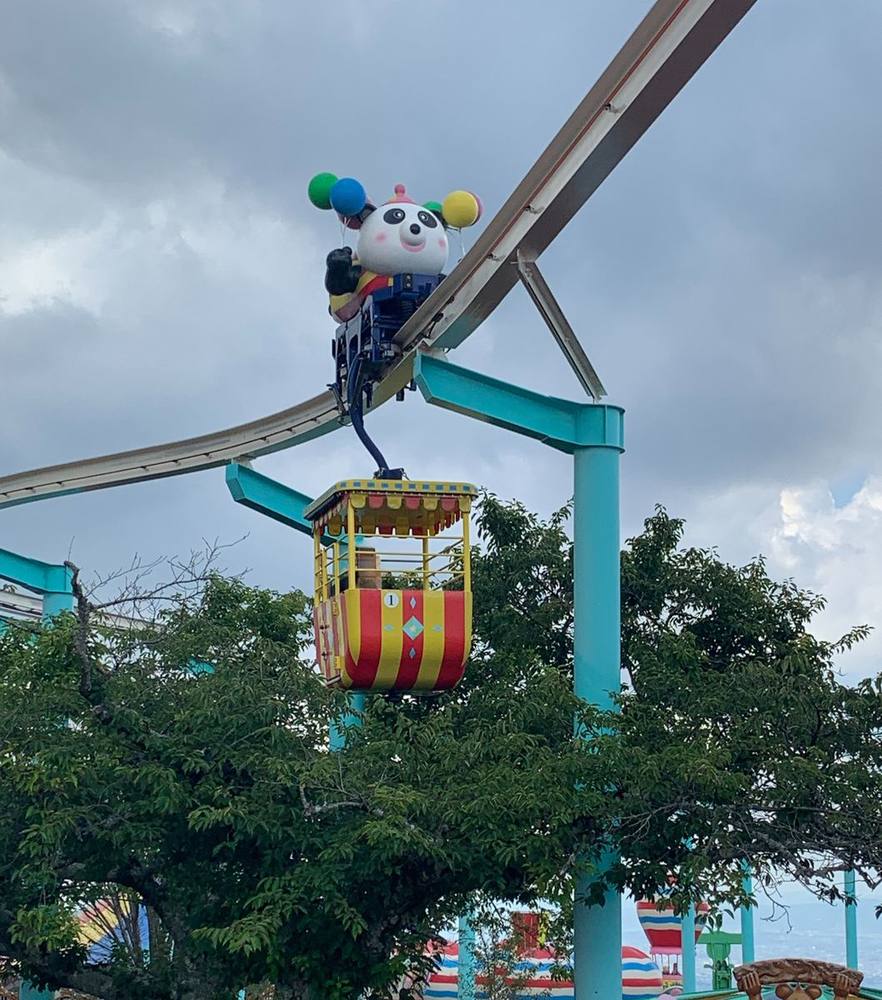 The Pukapuka Panda — a slow lap around the track with the scenery doing most of the entertaining.
The scorecard for a 4-year-old at 105 cm: she could ride almost everything in the park. The only attraction she wanted but couldn't ride was the Music Express, which requires 120 cm. Many rides here allow kids from age 0–2 with a paying adult, which makes this one of the more toddler-workable amusement parks I've covered.
Food, Toilets, and Practical Stuff
Lunch was the weak point of our day. We wanted the Ikomasanjo View Restaurant — the one with the panorama — but the line was long enough that we gave up and walked up the slope to Restaurant Hozan instead, which I'd describe, honestly, as a standard tourist-spot restaurant. It did come with a bonus mountain experience: a very large horsefly wandered in mid-meal. If you want the View Restaurant, shift your lunch earlier or later than noon, or resign yourself to the wait. Better yet, do what local families do and picnic on the lawns. Both restaurants accept cards and QR payments, a useful convenience at a retro park.
On toilets: they're properly cleaned and updated inside — Western-style, no squat surprises — but the buildings themselves are old, and the exteriors don't inspire confidence. The two I'd aim for are the one next to the SL train ride and the one just past the Gold Rush flume. There's no stroller rental, so plan on your own stroller or a carrier, and pack your own changing supplies rather than counting on polished baby facilities.
Getting There: the cable car is part of the day
From central Osaka this is a surprisingly simple trip, and the last leg is an attraction in itself — Japan's oldest cable car line, running cars shaped like a dog and a cat ("Bull" and "Mike") on the lower section and music-themed cars on the upper section.
The cable transfer at Hozanji sounds fiddly but is just stepping across to the connecting car. Get the Norinori Kippu (¥600 adult / ¥300 child) for the same-day round trip rather than paying each leg separately.
From Kyoto: take the Kintetsu Kyoto Line to Yamato-Saidaiji, change to a Nara Line rapid express to Ikoma — about 51 minutes and ¥830, then the same cable car.
By car: doable, but note the parking lot sits well below the entrance — we're talking hundreds of steps of elevation. There's a small funicular-style lift from the lot (a few hundred yen each way when we visited; check current fares). With a child aged 2 or under, buy the round trip — if you end up carrying a sleeping kid, descending those stairs is rough and genuinely risky.
How much English will you need?
Be ready to run on pictures and pointing. The park's official website is Japanese-only, signage on-site is Japanese, and you shouldn't expect English-speaking staff. Kintetsu (the railway) has a brief English page about the park, which is the best English-language starting point. The good news is that an amusement park is about as language-proof as attractions get: ride prices are posted as numbers, height limits are posted in centimeters, and buying a coupon book or Free Pass at the counter works fine with gestures and a translation app. The one place I'd pre-translate something is the closure calendar — screenshot the relevant dates from the official site before you commit to the trip.
Verdict
Good fit: families based in Osaka (or doing a Nara day) with kids roughly age 2–8, especially if your children are too small for the big-name parks — a 4-year-old can ride nearly everything here. Also anyone who values short lines over big thrills, and anyone who'd enjoy a vintage cable car and a mountaintop panorama as half the outing.
Less of a fit: thrill-seeking kids over about 10, who will exhaust the ride lineup quickly; visitors on a tight schedule who can't absorb a weather cancellation (rides stop in rain and wind); and anyone visiting Japan between December and early March, when the park simply isn't open.
This review reflects our family's actual visit. Prices and hours are as of 2026 and can change — always check the official Ikoma Sanjo Amusement Park website before you go. Questions about visiting Japan with kids? Get in touch.
Written by Tokyo Dad, a Japanese dad sharing family visits in Japan.